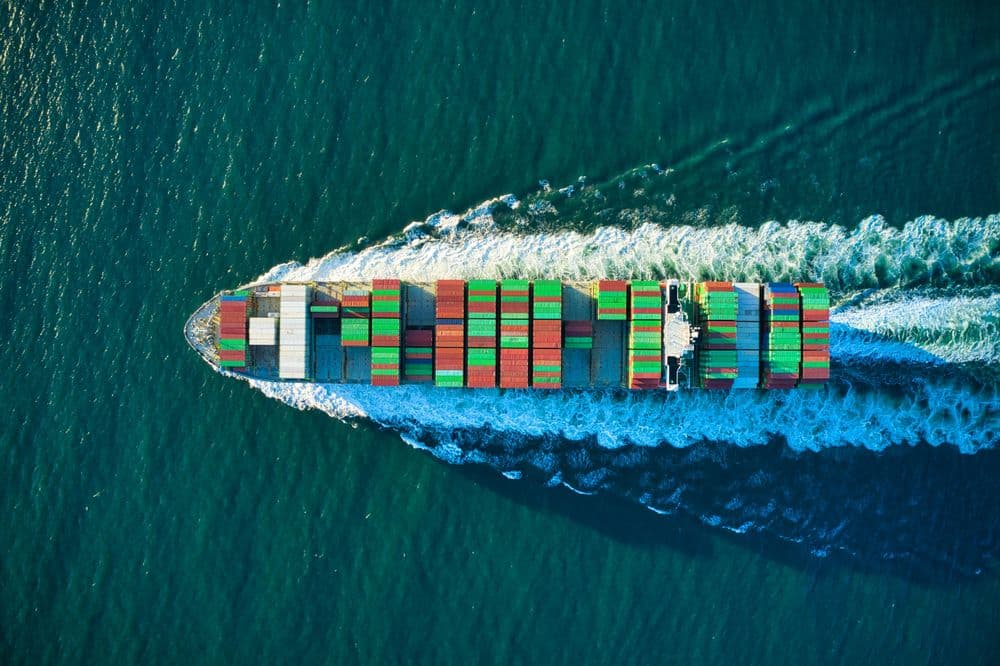
You can ship dangerous goods by sea freight as long as classification, packaging, documents and port notification comply with the IMDG Code. PLS handles IMDG shipments through Antwerp for classes 3, 4, 5, 8 and 9. We check your DGD and make sure the Harbour Master's Office is notified on time.
Two flows come up often: lithium batteries that importers bring in from Asia to Europe, and paints, chemicals and raw materials that manufacturers export worldwide. We handle other IMO cargo in these classes too. You deal with one contact person, from pickup to delivery.
Which dangerous goods do we ship?
The IMDG Code divides dangerous goods into nine classes. We ship six of them:
Class 2, gases: compressed and liquefied gases, for example aerosols (UN1950).
Class 3, flammable liquids: paints, adhesives, inks and solvents. Paint often falls under UN1263.
Class 4, flammable solids: including substances that give off dangerous gases in contact with water.
Class 5, oxidizing substances and organic peroxides: substances that can feed a fire, such as certain nitrates and peroxides.
Class 8, corrosive substances: acids and alkalis, for example phosphoric acid (UN1805) used in the soft drinks industry.
Class 9, miscellaneous dangerous goods: lithium-ion batteries (UN3480 and UN3481) and environmentally hazardous substances such as UN3082.
We don't accept explosives (class 1) or radioactive material (class 7). Damaged or defective batteries are out too.
How do you ship lithium batteries by sea?
Lithium batteries are class 9. They're the largest flow we handle, mostly imports from China and the rest of Asia into Europe. They look simple, but need more checks than most other classes.
We check:
- the UN number: UN3480 for lithium-ion batteries on their own, UN3481 for batteries contained in or packed with equipment;
- new or used: used batteries and batteries for recycling fall under different provisions than new ones;
- the state of charge: some carriers set their own requirements.
We don't ship damaged or defective batteries.
Who prepares the DGD and what do we check?
Under the IMDG Code, the shipper is responsible for correct classification, packaging and labelling, and signs the Dangerous Goods Declaration (DGD). Whoever loads the container signs the container packing certificate.
Before we book, we check:
- the DGD: UN number, class and packing group (PG);
- whether the safety data sheet (SDS) matches the DGD;
- the weights;
- which carriers accept the class on your route.
The earlier a mistake surfaces, the smaller the chance your container gets stuck at the terminal. Everyone on our team who books sea freight has completed IMDG training and holds a certificate.
Dangerous goods in LCL
An IMO shipment can also travel LCL in a shared container, through our partners. Whether that works depends on what's already in the container. The IMDG Code sets segregation rules: some classes can't share a container, and some dangerous goods can't travel next to ordinary cargo such as foodstuffs.
We check upfront whether your cargo can be combined with the rest of the container. If it can't, we look for another sailing or a full container (FCL).
Port formalities in Antwerp
Every container with dangerous goods must be notified to the Harbour Master's Office of Port of Antwerp-Bruges at least 24 hours in advance. Who files that notification depends on the carrier, and a missed notification can mean fines from thousands to tens of thousands of euros. The documentation cut-off for IMO cargo is also earlier than for regular containers, so allow a few extra working days.
ADR pre-carriage, on-carriage and storage
Dangerous goods travel to and from the terminal by road, where ADR applies. We arrange pre-carriage and on-carriage with hauliers in our network licensed for ADR transport.
If your cargo has to wait for a vessel or onward distribution, we have access to ADR warehouses in Belgium. For imports, we handle customs clearance through our customs services.