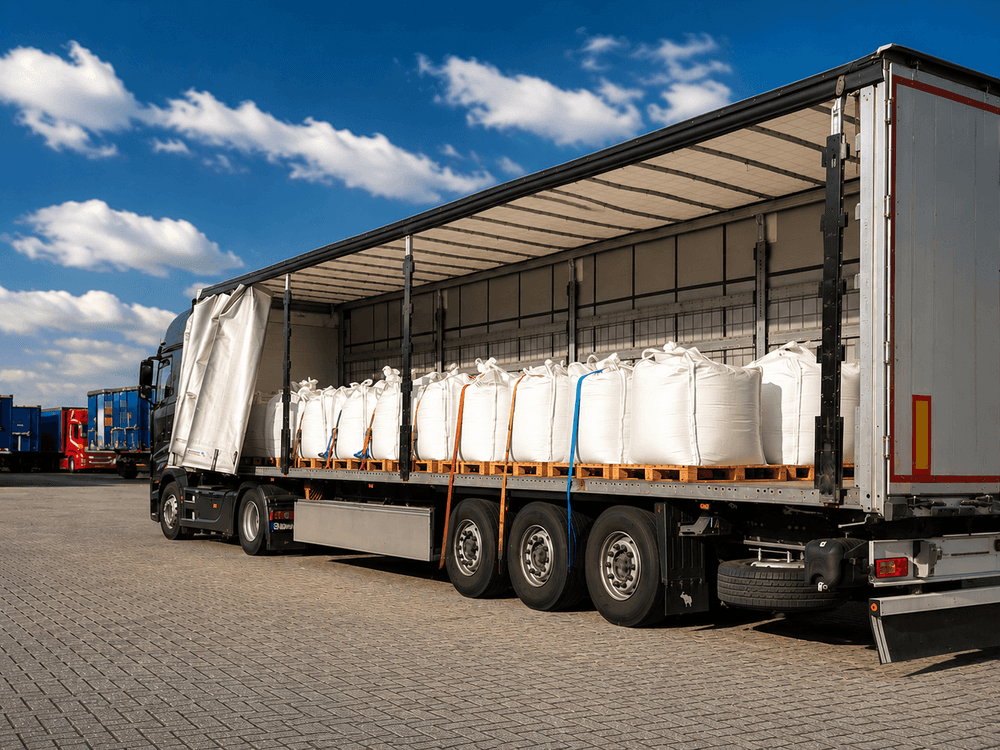
ADR transport is the carriage of dangerous goods by road under the European ADR agreement. PLS arranges your ADR transport of packaged goods across Western Europe, using carriers with a valid ADR certificate and an external dangerous goods safety adviser who monitors every shipment.
What is ADR transport?
ADR is the European agreement on the international carriage of dangerous goods by road. It sets out how you package, label, document and transport dangerous substances. Any such transport needs a driver with ADR training and the correct transport documents.
Dangerous goods are divided into classes. Each class has its own packaging and transport rules. Correct classification through the UN number and packing group is the basis of every ADR transport.
At PLS, an external dangerous goods safety adviser (DGSA) oversees that compliance. We keep a record of each transport, listing weight and class. Our DGSA reviews that record every month.
Which dangerous goods does PLS transport?
We transport packaged ADR goods in the most common classes:
- Class 3: flammable liquids
- Class 6.1: toxic substances
- Class 8: corrosive substances
- Class 9: miscellaneous dangerous substances
This concerns packaged transport, not bulk. In practice we load IBCs, drums, jerrycans and palletised goods, both as full loads and as part loads.
We do not handle tank transport or bulk. We deliberately leave that to specialised tank carriers. This way, for your packaged dangerous goods, you keep a single point of contact who knows the subject inside out.
How does an ADR transport work at PLS?
Before we confirm a price and schedule, we map out your shipment. We routinely ask for the following details:
- UN number and class
- Packing group
- Number of parcels or IBCs
- Loading and delivery address
- Whether the shipment falls under limited quantities (LQ)
With these details, we plan the transport with a fixed carrier from our network. We work only with partners whose drivers hold a valid ADR certificate. For every order, we check that the carrier is allowed to carry the class involved. You get a single point of contact who follows your file from the first question.
ADR distribution and storage in Belgium
Some shippers may only keep a limited quantity of their product in IBCs, and store the rest as bulk in silos. That makes smooth, daily delivery difficult.
For a regular client, we solve this with a combined storage and distribution setup. We load over three days and place the filled IBCs in an ADR warehouse from our network. From there, we deliver a few IBCs each day to the various delivery addresses.
This keeps the client within the limits of their storage permit while keeping their product available every day. This approach runs on a weekly and monthly basis.
ADR transport across Western Europe
Our core area for ADR transport is the Benelux and neighbouring countries. We drive nationally within Belgium and internationally to the Netherlands, Germany and France among others, in full and part loads.
Because we work with a fixed network of ADR-approved carriers, we also keep cross-border oversight of the correct documents and the right class approval.
When dangerous goods travel in containers to or from the port, ADR road haulage and sea freight come together. In those cases we combine this service with the transport of dangerous goods in containers.
SQAS and safety monitoring
PLS underwent a SQAS assessment in February 2026, under the Transport Service module. This assessment was carried out within the Cefic-SQAS system and is valid until February 2029. SQAS is a factual review that international partners and chemical companies use to evaluate logistics providers.
Our operation also relies on structural safety monitoring. Our external DGSA reviews the record of all completed ADR transports every month. This keeps the monitoring of your dangerous goods constant and verifiable.