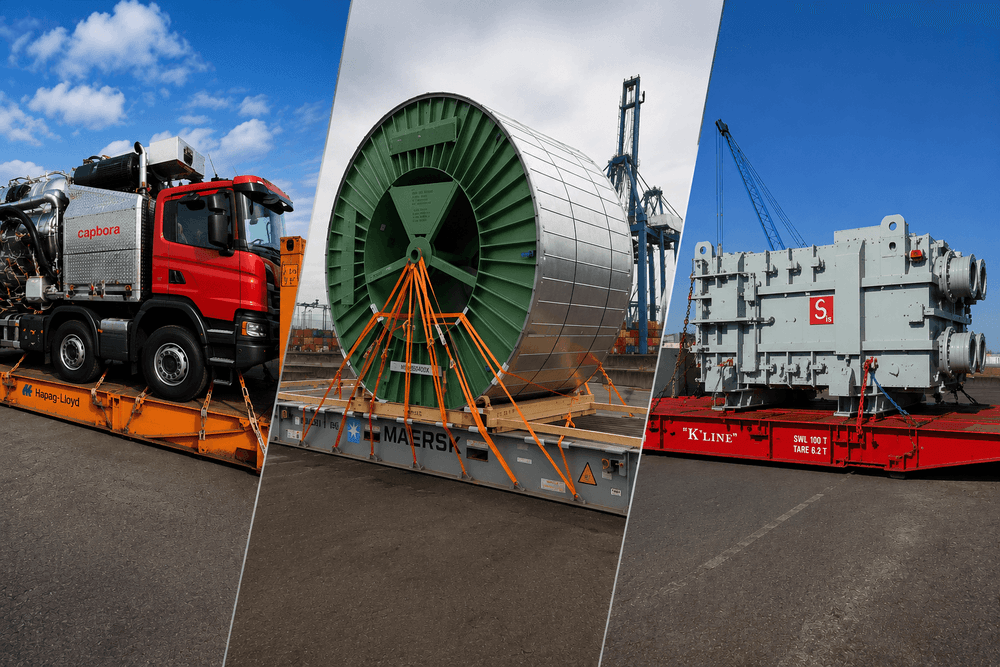
An abnormal load is any road shipment that is wider, taller, longer or heavier than the legal limits. In Belgium, that means anything over 2.55 m wide, 4 m high or 44 tonnes. PLS organises abnormal load transport as a freight forwarder from Antwerp: route, permits, haulier and escort.
When does a shipment count as an abnormal load?
One dimension is enough. A 9-tonne silo that is 4.48 m wide is just as much an abnormal load as a 65-tonne transformer.
In practice, size causes more problems than weight. And the limits change at every border. A load 4.10 m high needs a permit in Germany, because the limit there is 4 m. It's the question we get asked most. If your cargo stays within all limits, it travels as standard road transport.
What kind of cargo do we move?
Much of our work is industrial machinery, where the centre of gravity decides how a machine sits on the trailer. Transformers are the opposite case: compact, but between 35 and 65 tonnes, so the weight has to be spread carefully over the axles. Silos and pressure vessels up to 45 tonnes are bulky and relatively light, which means width and height dictate the route.
Wind turbine blades are all about length and a route without tight bends. Agricultural vehicles and buses become abnormal loads once they sit on a low loader and the height or width goes over the limit. We also move coils and boats regularly, each with its own securing method.
What are the maximum dimensions in Belgium, the Netherlands, Germany and France?
Below are the standard limits per country and what happens above them. For deck heights and trailer types, see our article on trailer dimensions.
Belgium
A standard truck may be 2.55 m wide and 4 m high, with a maximum of 44 tonnes for a five-axle combination. Above that, Belgian rules split abnormal vehicles into four categories. Category 1 goes up to 3.50 m wide. Category 2 goes up to 4.25 m wide, 4.50 m high and 90 tonnes. Category 3 goes up to 5 m wide, 4.80 m high and 120 tonnes. Anything bigger is category 4.
The Netherlands
The legal limit is 2.55 m wide and 4 m high. With an annual exemption from the RDW, a load can be up to 3.50 m wide, 4.25 m high, 27.50 m long and 100 tonnes. Above that, a one-off exemption is required. Over 4.40 m high, a route survey is mandatory.
Germany
Germany allows 2.55 m wide, 4 m high, 16.50 m long for an articulated truck and 40 tonnes. Above those limits you need a permit under § 29 StVO, applied for through the VEMAGS portal. Within certain dimensions this can be a standing permit valid for up to three years. Otherwise, each journey needs its own permit.
France
France allows 2.55 m wide, 16.50 m long for an articulated truck and 44 tonnes. French law sets no general maximum height, so the route has to be planned around the height of the load. A convoi exceptionnel falls into three categories: up to 3 m wide and 48 tonnes, up to 4 m wide and 72 tonnes, and everything above.
Which permit do you need for an abnormal load?
It depends on the size of the load. There are two types: a long-term permit for loads within certain dimensions, and a temporary permit for one specific movement.
Most of the shipments we organise run under our hauliers' long-term permits. In Belgium, these are valid for up to five years in category 1 and up to one year in category 2. The Dutch equivalent is an annual exemption, the German one a Dauererlaubnis.
For the really large pieces, we apply for a temporary permit per movement, with a fixed route. In Belgium, it is valid for up to four months in category 3 and up to two months in category 4. Since 2015, the Belgian regions handle these applications through the WebTeuv system.
How do we prepare a large abnormal load movement?
For pieces outside any long-term permit, the work starts well before the truck rolls. This is how we approach it:
- Technical review. We map dimensions, weight, weight distribution, centre of gravity and lifting eyes. That decides the haulier and the trailer type.
- Route survey. A specialist company drives the route several times and logs every point where it gets difficult.
- Alternatives. Where a passage doesn't work, we look for another way through or another route.
- Permits. Our partners apply for permits in every country and region the load passes through.
- Infrastructure coordination. We notify the road authority, and coordinate with the public transport operator when tram lines need to be switched off and with the grid operator when cables hang in the way.
- Loading and driving. Crane, loading slot and haulier have to be ready at the same moment. On complex jobs, someone from our team rides along with the convoy.
If the load crosses a border or leaves the EU, the customs formalities are done before departure. If a loading slot moves or a ferry is cancelled, we find an alternative through our network and tell you and the haulier straight away.
What if the road is not enough?
At extreme weights and lengths, the road runs out. We then combine road transport with inland shipping: a short pre-carriage to an inland port, transfer to a barge and delivery as close to the destination as possible.
One request in 2026 was for a 90-tonne pipe, 49 m long, from central Germany to the Dutch coast. Road alone was not an option, so we looked at a route by road and inland waterway. To assess it, we needed technical data: is the pipe self-supporting, how many support points can it rest on, are there lifting instructions, and is there crane capacity at both ends.
If there is no waterway option and the road won't allow it, we tell you plainly. Some loads simply can't move.
An example of a complex movement to the United Kingdom
In September 2026, we moved a silo from Antwerp to the Liverpool area. It measured 11.35 m long, 4.48 m wide and 4.30 m high, and weighed 9 tonnes. It travelled on a low loader.
At 4.48 m wide, a load like this is category 3 in Belgium, with a temporary permit and a fixed route. The hard part was the ferry crossing and a tight schedule: departure, boarding and the drive on the UK side had to line up to the hour. We move silos regularly, so we knew in advance how this load behaves during loading and securing.
What do we need for an abnormal load quote?
The more complete your first email, the faster you get a usable quote. Please send:
- Length, width and height of the load
- Total weight
- Weight distribution and centre of gravity
- Position of the lifting eyes or lifting points
- Technical drawings, if available
- Loading and delivery address, including quay or terminal if relevant
- Crane capacity at loading and delivery
- Preferred date or time window
- Photos of the load
Weight distribution is what's missing most often. It determines the axle loads, and the axle loads determine the trailer type and the number of axles. A 30-tonne machine with its weight at one end needs a different set-up than a 30-tonne silo with the weight spread evenly.
How do we follow up an abnormal load?
A project with several pieces quickly means several hauliers, loading slots and permits at once. We coordinate all of it, so you deal with one party instead of five. The whole team knows the file: when you call, you reach someone who knows where your cargo is right now. On complex jobs we follow the convoy in person, backed by almost 40 years of experience with out-of-gauge cargo.
Can we film your abnormal load?
Yes, on selected projects. A regular partner shoots drone and gimbal footage of the loading, the journey and the unloading. You get an edited video for your website and LinkedIn.
We choose which projects qualify. If you have a movement you'd like on camera, mention it in your request.
What if the cargo needs to go overseas?
Then we arrange the sea leg from the Port of Antwerp-Bruges, on a flat rack, a mafi trailer or as breakbulk. Where needed, the cargo is shrink-wrapped for protection. More on our sea freight page.