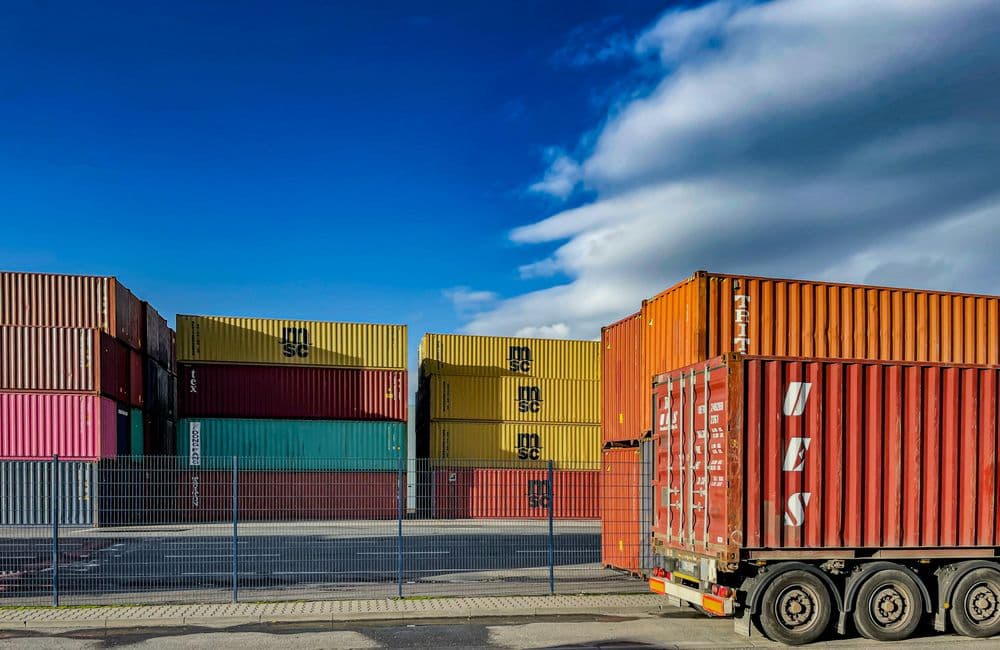
Machinery transport on a project scale means moving complete production lines and factories, inbound and outbound through the Port of Antwerp-Bruges. We handle the transport and, where needed, the crane work, sea freight, storage and customs. The dismantling itself you arrange beforehand with a specialised company.
What does project-scale machinery transport involve?
This is not about a single machine haul. It covers entire lines and complete factories, with dozens to hundreds of trucks per project.
The work runs in two directions. Outbound, we clear a purchased factory or production line and ship it out, often by sea container to a buyer abroad. Inbound, we fill a new factory with parts arriving through the port.
Heavy or oversized parts we move as abnormal transport. For road transport within Belgium and Europe we use our own equipment. For the wider picture, see our project logistics page. This subpage focuses on machines and production lines.
Who do we transport machinery for?
Our clients are industrial buyers, auction houses and brokers who trade complete factories and machine parks. We also work for importers and owners who need a purchased line removed or delivered.
These parties buy and dismantle themselves, or have it done. What they need is a carrier who can handle large volumes under time pressure. Often there is a hard deadline, such as a site closure or an expiring lease.
How does clearing or filling a factory work?
First, the buyer engages a specialised company to disconnect and centre the machines. Pipes and lines are uncoupled. Only once everything is ready for transport do we step in.
We handle the transport. Where needed, we place a crane with operator on site for weeks. We do not dismantle or rebuild anything ourselves.
When filling a new factory, everything turns on the delivery slots. Each truck has to be on site at a fixed time. In 2025, for example, we handled the inbound flow of 60 containers with parts for a power plant, which we stripped and delivered per booked slot.
What happens when the schedule slips?
A delay in one link pushes the whole timetable back. A terminal that releases late, or a truck that misses its slot, puts the order of the entire day at risk.
We then reshuffle the sequence of the remaining trucks. If it runs further behind, we add an extra truck the same day to get the schedule back on track. That keeps the site running and the delivery slots intact.
Loose in the container or palletised?
That depends on the part. Large, sturdy pieces can take a knock and go loose in the container. Small material such as bolts and non-essential piping is hard to palletise and travels in crates.
Fragile items such as control cabinets and motors do go palletised and secured. That way everything travels along without wasting container space.
Why keep machinery transport with one partner?
For an overseas factory sale, we can carry the full chain. That runs from the pre-carriage to the quay, through the sea freight from Antwerp, storage and transhipment, to the customs formalities such as the T1 document and the EUR.1.
One point of control works faster. And it stops several carriers from getting in each other's way at the delivery gate. We have seen another party's delay put our own slots at risk. With a single point of contact, that does not happen.
We can do a lot, but not everything. That is why we always ask for the concrete specifications: dimensions, weights and the nature of the machines. So we tell you honestly, up front, what is and is not feasible.
Planning the removal or delivery of a production line or factory? Send us the specifications and the deadline, and we will look at the approach together. Request a quote without obligation, or call us directly.