From 18 February 2027, the EU requires a battery passport for industrial batteries above 2 kWh. For importers, two things arrive at once: extra admin and containers that weigh up to 55 to 60 tonnes. A BESS container like that only leaves the quay as an abnormal load.
What changes under the EU battery law from 2027?
The EU Battery Regulation (Regulation EU 2023/1542) requires a battery passport for every electric vehicle battery, for light means of transport such as e-bikes and e-scooters, and for every industrial battery above 2 kWh. A QR code on the battery links to a machine-readable passport with data on capacity, lifespan and material composition.
That 2 kWh threshold also covers the BESS container. This is a transportable, large-scale battery storage system built into a standard sea container. An importer bringing these containers in from China carries the passport responsibility as the European operator.
The law actually reaches wider than transport. Forklifts and automated warehouse robots running on batteries above 2 kWh also need a passport. For your goods flow, though, the heavy BESS container is what counts.
Why does a battery container suddenly become an abnormal load?
This is the first surprise for many importers. Where these containers weighed around 35 tonnes until recently, the weight now climbs towards 55 to 60 tonnes. At that weight, standard container transport no longer works.
A sideloader is out. To lift a container like that off the chassis, you need a crane. And the weight shapes the route: an abnormal load cannot cross every bridge. In practice this is almost always solvable, as long as you check it up front.
Moving from normal to abnormal transport is a jump if you do it for the first time. Permit, crane, route survey: it all comes with the job. We handle those parts for you.
Why does the Antwerp quay clog up?
On the Antwerp quay, free open-air storage runs to 30 days at most. Against ports like Valencia, where you get five to eight days, that is generous. Even so, the term is not a buffer you should count on.
The bottleneck is removal. These heavy containers leave the quay slowly, because every move needs an abnormal load. If a ship discharges a hundred of them, five to ten removals a day are not enough to clear the quay in time.
On top of that, terminals do not want ADR and battery containers sitting there, certainly not in the open air. The quays are full anyway. So the pressure to move comes from two sides: the clock and the terminal itself.
How do you still get a container like that off the quay quickly?
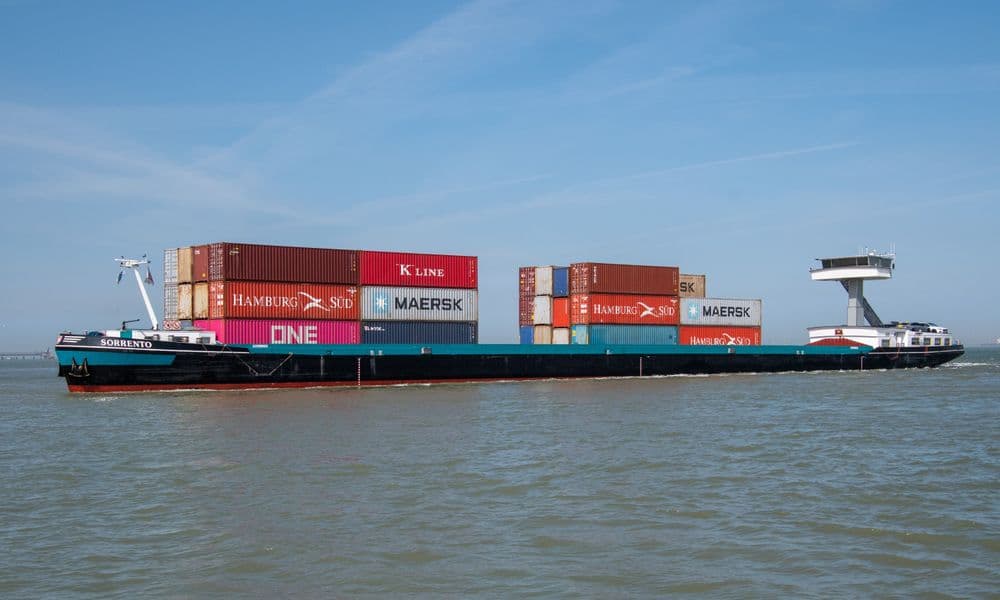
This is where we make the difference. Instead of struggling with a handful of moves a day, we remove the containers by barge to a warehouse. Over the water, you take a whole load off the quay in bulk, while others are stuck on ten heavy removals a day.
That bypasses the bottleneck. The containers leave the quay fast, you no longer depend on limited abnormal-load capacity at peak times, and the terminal is glad to see the battery containers go.
What about customs and the battery passport?
The battery passport is tied to customs clearance. If the required data is missing or wrong, your container does not leave the quay easily. Accurate, timely admin matters as much as the physical transport.
We handle the customs formalities for your shipment. What we do not do is create or complete the battery passport itself. That responsibility sits with you as the importer, or with the party placing the battery on the European market. We are your forwarder, not the passport provider. Make sure that data is in order before the ship arrives.
Why it pays to plan now
The timing is not a detail. With the Chinese export VAT rebate falling from 6% to 0% in early 2027, manufacturers are trying to ship as many containers as possible before that date. A sharp rise in arrivals is expected in Q4 2026 and Q1 2027.
During that peak, everyone wants to move heavy containers off the quay at the same time. And abnormal-load capacity is limited. Plan in time and you are fine. Wait for the peak and you are at the back of the queue.
We work with a broad network of hauliers for abnormal loads, including foreign operators already heading to Antwerp. That gives us more room to find capacity when the pressure builds. So contact us a few months ahead rather than a few days.
Plan your BESS container transport in good time
Expecting battery containers via Antwerp in the coming months? Send us your quote request or get in touch to plan ahead for the peak in late 2026 and early 2027. The earlier we look at it with you, the more room you have.
Contact us here
Sources
Flows – Batterijpaspoort en logistieke krapte eisen uiterste van de keten
EUR-Lex – Regulation (EU) 2023/1542 on batteries and waste batteries
European Commission – Batteries: waste and recycling