Event logistics means moving materials to and from events, exhibitions and competitions within a fixed time slot. PLS handles that across Europe, by container or by truck. We plan the runs, call the loading and unloading sites, and track every movement, including outside office hours.
What makes event logistics different from regular transport?
Regular freight runs on transit time. An event runs on the clock. An exhibition hall opens at a set moment, a circuit grants access on a schedule you do not control, and a festival site is empty again three weeks later.
Arrive early and your driver waits with nobody to unload him. Arrive late and he faces a closed gate. Those two risks shape how we build a file.
Access is the next problem. Many event sites were never designed for a trailer or a 40ft high cube. Think of a street circuit like Monaco, or a fairground where the last five hundred metres run through a residential area. You need to know that before the driver leaves, not once he is standing there.
Which equipment do we use for events and exhibitions?
It depends on the cargo. Stand materials, sets and machinery for a trade fair usually travel on a curtainsider or a closed truck, because loading and unloading happens from the side or the rear. Anything too tall, too heavy or too awkward for a closed truck, such as stage sections, structures or machinery, goes on a flatbed or a low loader. Material that travels a full season and stays on site between stops goes into containers.
Either way, we work in full loads. We carry single pieces as well, but not as groupage with a long list of time slots.
In practice this covers trade fairs and exhibitions, multi-day festivals, sporting events with a travelling build, and shows that move from city to city.
How does container traffic between event sites work in practice?
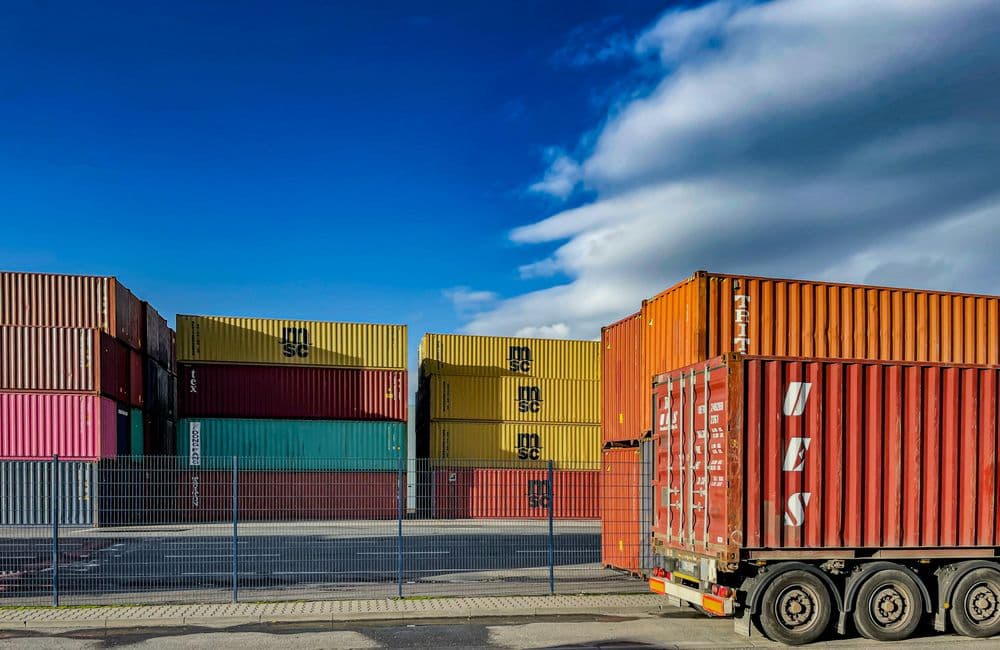
Since 2025 we have been running one-way container traffic for an international sporting calendar that crosses eight European countries. The material moves from site to site in 40ft high cubes, with sideloader handling at both ends.
A project like that runs to around thirty containers. Every movement has its own arrival window and its own contact on site. For some destinations we build in two days of waiting time, because unloading can only happen at a fixed moment.
Who tracks the runs when something goes wrong at night?
We do. This is where the work stands or falls.
Event logistics happens outside office hours. An unloading slot at 5 am, a driver at a closed barrier at 10 pm, a site manager who only picks up once the build is done. We work those hours and stay in direct contact with the drivers, rather than through a dispatch system that gets read the next morning.
Our fixed network of hauliers across the European Union works the same way. Call us and you reach a mobile that is answered around the clock.
That is also our honest answer to the question of whether we are too small for a thirty-container project. Larger operators have more trucks. After 7 pm you get their voicemail.
Why use a forwarder for a project like this?
Because somebody has to keep the overview. With thirty movements across eight countries, you would otherwise be calling thirty drivers, as many loading and unloading sites, and a few terminals in between.
We collect that information and bundle it. You get one contact who knows where every container is, what its status is and what needs to happen today. We handle the coordination with the sites, including the calls nobody enjoys making.
Where can containers wait between two events?
We have depots in the Benelux and Germany, used in three ways.
A container not due at the next site for another ten days goes into a depot, instead of sitting on a site where it blocks the space. At the same locations we swap trailers when planning or EU driving time rules require it. And when the final destination cannot take a container, we tranship there onto equipment that can reach it.
Can you store sets and stand materials as well?
Yes. Alongside containers we store loose event material in our warehouse. Think of set pieces, stand walls, banners, flight cases, furniture and the packaging you only need again at teardown.
For material that goes out a few times a year, this usually costs less than keeping a unit of your own. You tell us when it needs to leave, we load it and take it to the next site. Between two trade fairs it simply stays with us.
What we do and don't do
We do:
- Road transport by curtainsider or closed truck to exhibition halls and event sites
- Road transport by flatbed or low loader for stage sections, structures and machinery
- Container transport to and from event sites across Europe
- One-way traffic between consecutive locations
- Interim container storage at our depots in the Benelux and Germany
- Warehouse storage of sets, stand materials, flight cases and packaging between events
- Crane work where the job calls for it
- Last-minute requests, subject to equipment being free
- ATA Carnet
We do not:
- Groupage built on a series of separate appointments and time slots. This work moves in full loads or containers
- Stand building or teardown on site