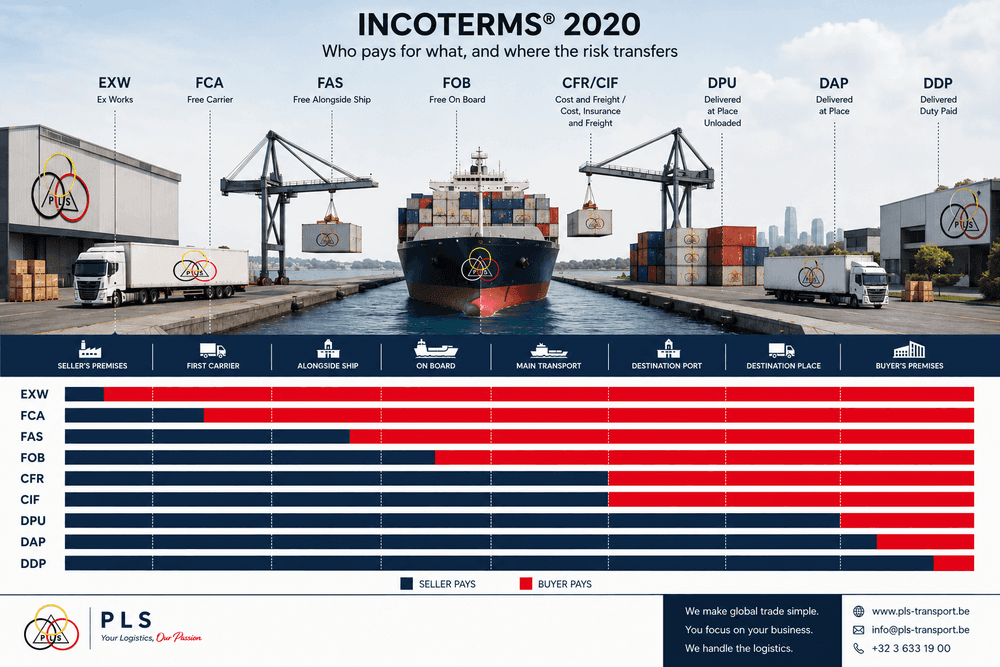
Incoterms are international rules that set out who arranges the transport, who pays which costs, and at what point the risk passes from the seller to the buyer. There are 11 terms. The current version is Incoterms 2020, in force since 1 January 2020.
This guide explains what each term means and, more importantly, which term fits your situation. If you prefer a quick overview to keep on hand, you can download our free guide.
What are Incoterms?
Incoterms stands for International Commercial Terms. They are published by the International Chamber of Commerce, or ICC. An Incoterm is a three-letter code that you put in a sales contract or on a transport document. It settles three things:
- Who arranges the transport.
- Who pays which costs.
- At what point the risk passes from the seller to the buyer.
That last point means: from which moment the buyer carries the cost of damage or loss along the way.
Always state an Incoterm together with a place and the year. For example: FCA Antwerp, Incoterms 2020. Without a place and a year, the agreement is incomplete.
A few basic words, for anyone who does not work with this every day. The seller is the party that supplies the goods. The buyer is the party that purchases them. The carrier is the company that performs the transport. The transfer of risk is the point where responsibility for the goods moves from the seller to the buyer.
The 11 Incoterms at a glance
The terms fall into two groups. Seven terms apply to any type of transport. Four terms apply only to transport by water.
For any mode of transport (road, rail, air, sea):
- EXW (Ex Works): the buyer collects the goods at the seller and arranges everything after that.
- FCA (Free Carrier): the seller delivers the goods to the buyer's carrier. The correct term for containers.
- CPT (Carriage Paid To): the seller pays the transport to the destination, but the risk passes earlier.
- CIP (Carriage and Insurance Paid To): like CPT, but the seller also takes out insurance.
- DAP (Delivered at Place): the seller delivers at the agreed place, ready to be unloaded.
- DPU (Delivered at Place Unloaded): like DAP, but the seller also unloads the goods.
- DDP (Delivered Duty Paid): the seller arranges and pays for everything, including the import duties.
For sea and inland waterway only:
- FAS (Free Alongside Ship): the seller delivers the goods alongside the ship.
- FOB (Free On Board): the seller delivers the goods on board the ship.
- CFR (Cost and Freight): the seller pays the sea freight, but the risk passes earlier.
- CIF (Cost, Insurance and Freight): like CFR, but the seller also takes out insurance.
Cost and risk are not the same thing
This is the mistake people make most often. Many assume that whoever pays for the transport also carries the risk. That is not always true.
Take CIF. The seller pays the sea freight to the port of destination. But the risk already passes as soon as the goods are on board in the port of departure. If something goes wrong along the way, that is for the buyer, even though the seller pays the freight. The same applies to CFR, CPT and CIP.
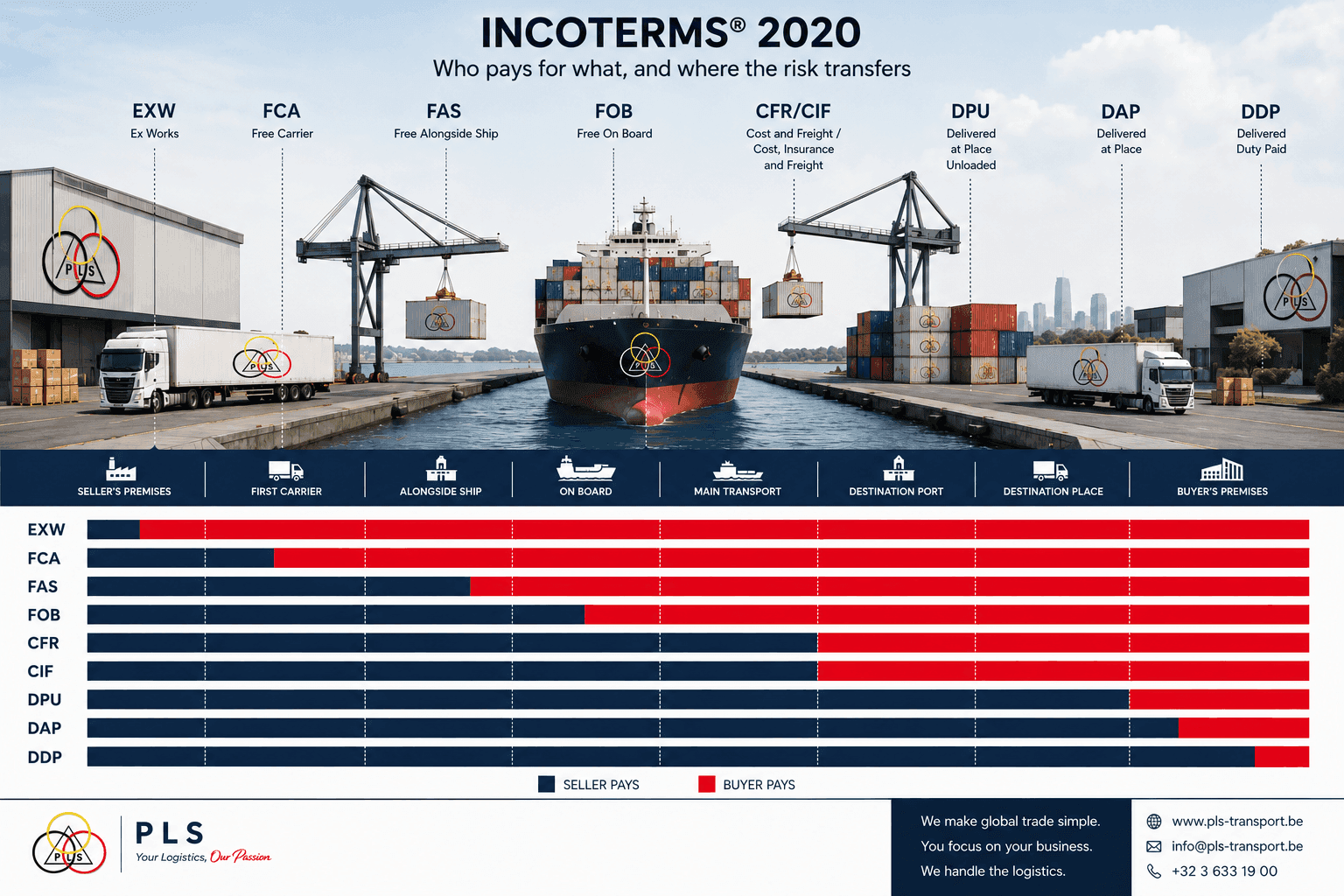
The infographic above shows this split per term. In short: from EXW to DDP, the seller takes on more step by step. Under EXW the buyer does almost everything. Under DDP the seller does almost everything. The terms in between divide the costs and the risk at different points of the journey.
Which Incoterm should you choose?
The right term depends on the type of goods, the mode of transport, and who organises the transport. Below are the most common situations.
Container transport by sea. Choose FCA, CPT or CIP. If you arrange the transport as the seller and also want to insure it, CIP makes sense. If the buyer arranges the transport, FCA fits. An example: a machine leaves Antwerp for Canada in a container. The seller books the sea freight and insures the cargo. CIP to the place in Canada is then a clean choice.
Road transport within Europe. Choose DAP or DDP in most cases. If the seller delivers to the customer, DAP is common. Within the European Union there are no import duties, so DAP is often enough. If the seller wants to handle every formality, DDP is possible. If the buyer arranges the transport, FCA is the choice.
Bulk goods by sea. Here FOB, CFR and CIF are the correct terms. Bulk really does go on board the ship, over the rail. Think of grain, ores or liquids that go straight into the hold or into tanks.
The seller arranges everything. Choose DDP. The seller delivers to the buyer and also pays the import duties and the customs formalities. Convenient for the buyer, but the seller carries the most.
The buyer arranges the transport. Choose FCA rather than EXW. EXW looks simple, but then the buyer also has to handle the export formalities in the seller's country. That is often difficult. Under FCA the seller handles the export, and that usually runs more smoothly.
One more example that comes up a lot. A Belgian importer buys goods from China. In practice, many Chinese suppliers offer FOB or CIF. For containers, FCA or CIP would be technically more correct, because a container is handed over at the terminal and not on board. So be aware that FOB and CIF are common for containers, but they do not place the risk in the right spot.
The common mistake: FOB and CIF for containers
FOB, CFR and CIF assume that the goods are loaded on board the ship. The risk passes at the moment the cargo is on board. That works well for bulk, but not for containers.
A container is handed over earlier, at the container terminal. From that moment you no longer control it yourself. The container is stacked, moved and only later placed on board. If you then choose FOB, the seller stays responsible on paper until the cargo is on board, while in reality he can no longer reach it. That gap leads to disputes when something goes wrong along the way.
This is why FCA is the right choice for containers. Under FCA the risk passes at the moment the container is handed over at the terminal. That matches how the transport actually works. If the seller also wants to arrange the freight and the insurance, CPT and CIP are the container versions of CFR and CIF.
Is there an Incoterms 2026 or 2030?
No. Incoterms 2020 is the most recent version and remains in force. There is no Incoterms 2026. The ICC revises the rules roughly every ten years. A next version is therefore expected around 2030, but the ICC has not confirmed a date for it. So use Incoterms 2020 in new contracts.