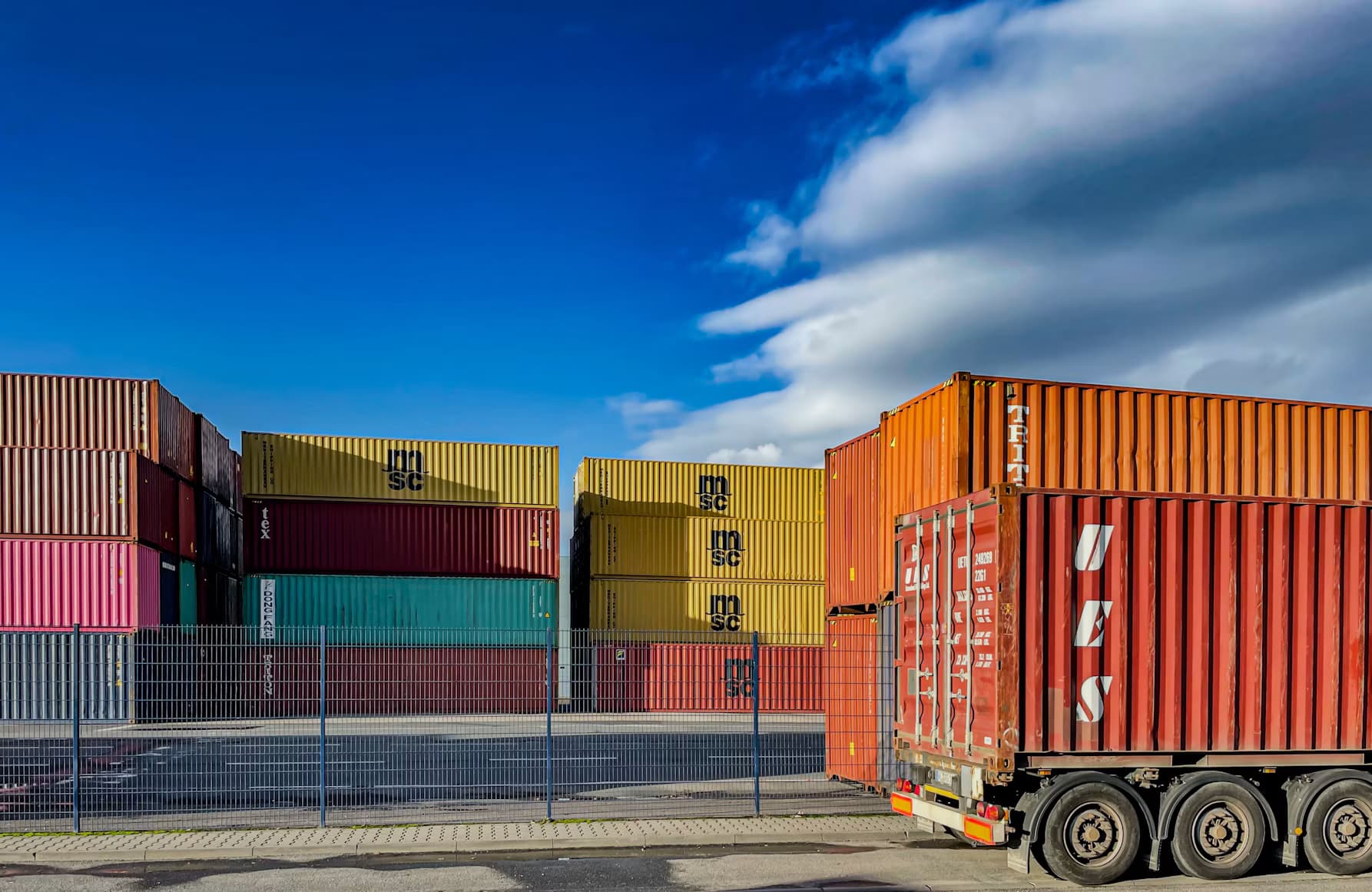
Importing from China usually runs by sea freight to the Port of Antwerp. You pay import duties and VAT based on the customs value, and the commodity code sets the rate. A freight forwarder handles the transport, the customs clearance and the delivery to your warehouse.
How does importing from China actually work?
A shipment from China follows a fixed route, but the planning can shift at every step.
The goods leave the Chinese supplier and are booked onto a vessel, as a full container (FCL) or as groupage (LCL). After arrival at the Port of Antwerp, the terminal releases the container, and customs clearance follows. Only once cleared can the container leave the terminal for your warehouse.
Companies setting up this chain for the first time often underestimate what happens between arrival and delivery. A container is not ready on demand. Terminal procedures, releases, time slots and possible inspections decide when the transport can actually run. A forwarder who knows the port aligns these steps and gives you one point of contact for the whole move.
What does importing goods from China cost?
Importing from outside the EU means paying three things: the freight, the import duties and the import VAT. The last two are calculated on the customs value.
The customs value is the goods value plus transport and insurance up to the external border of the EU. That is the CIF value. On this amount, customs calculates the import duties according to the commodity code rate. VAT is then added on top of the customs value and the import duties combined.
For Chinese goods, one point needs attention. On certain product groups, the EU applies anti-dumping duties on top of the ordinary import duties. These can run high. Whether they apply depends, again, on the commodity code and the precise description of your product.
How do you calculate import duties and VAT?
The calculation always follows the same order. The order matters, because VAT is charged on the import duties as well.
- Determine the customs value: goods value plus transport and insurance up to the EU border.
- Calculate the import duties: the commodity code rate applied to the customs value.
- Calculate the import VAT: apply the VAT rate of the country where you clear the goods to the customs value plus the import duties. This example assumes clearance in Belgium via Antwerp, so 21%.
A worked example with round figures, based on clearance in Belgium. Take a shipment with a goods value of 20,000 euros and 2,000 euros of transport and insurance to the border. The customs value is then 22,000 euros. If the import duty for this product is 6%, you pay 1,320 euros in duties. The VAT base becomes 22,000 plus 1,320, or 23,320 euros. At the Belgian rate of 21%, the VAT comes to 4,897.20 euros. The import charges together add up to 6,217.20 euros.
Important: the 6% rate is only an example here. The real percentage depends entirely on the commodity code and the country of origin. For some products it is 0%, for others it climbs, and anti-dumping adds a further charge. A worked example gives an order of magnitude, not a guaranteed amount. The import duty is the same across the EU, but the VAT rate depends on the country where you clear the goods: 21% in Belgium, 19% in Germany, 21% in the Netherlands.
For VAT-registered businesses, import VAT is usually deductible through the VAT return. The real cost lies mainly in the import duties themselves and in pre-financing the VAT.
Why does the commodity code decide everything?
The commodity code, also called the HS or TARIC code, determines your duty rate, whether anti-dumping applies, and whether a trade agreement allows a lower rate. One digit difference in the code can mean a different rate.
This is where things most often go wrong. An incorrect or too broad classification leads to the wrong rate, which surfaces sooner or later during an inspection. Additional assessments, delays and disputes with customs follow. Choosing the right code is not a formality, it is the basis of your entire cost price.
How do you keep import VAT out of your cash flow?
When you clear goods in Belgium via Antwerp, an E.T. 14.000 licence lets you reverse-charge the import VAT to your periodic VAT return instead of paying it at the border. For businesses with recurring import flows from China, that is a reason to structure the setup well from the start.
PLS coordinates the full import route from China: sea freight to Antwerp, container transport, customs clearance and onward transport to your warehouse. We advise on the commodity code and the customs setup, so you are not caught out on arrival.