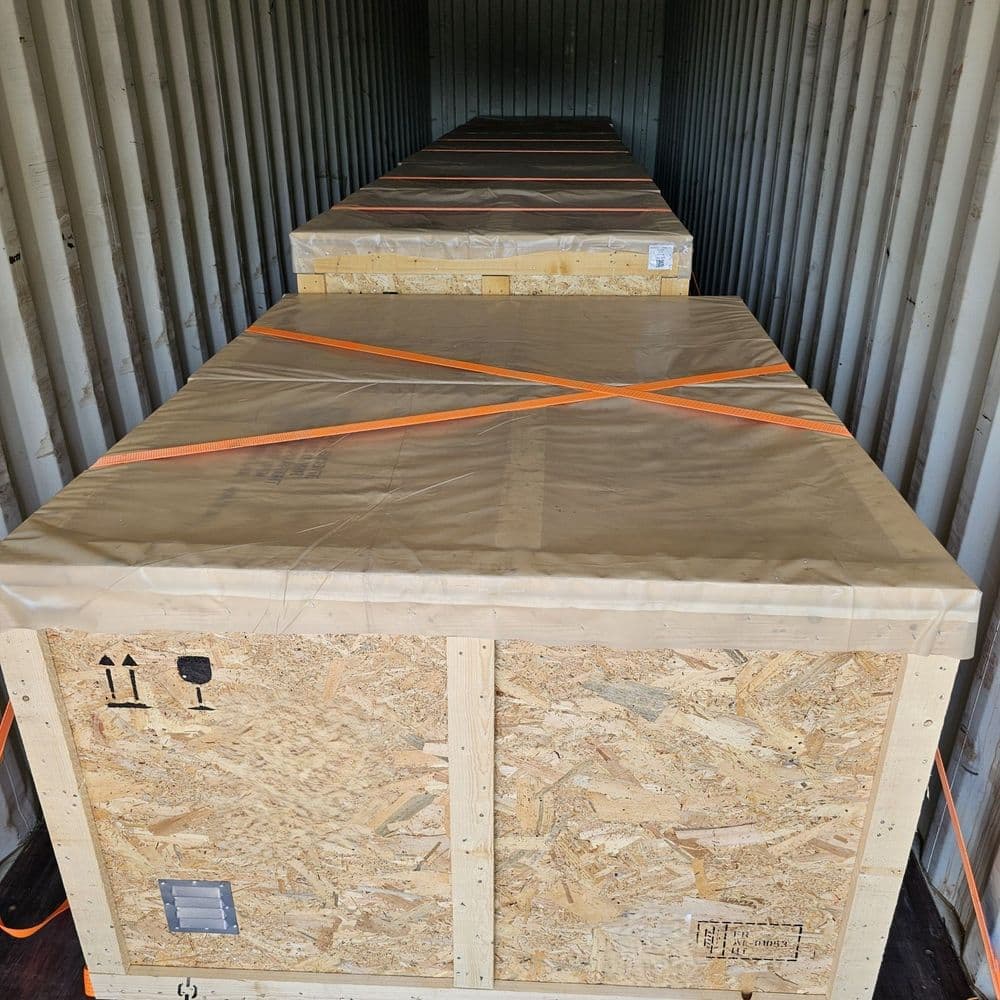
Fumigation is a gas treatment that kills pests inside a container before it leaves, usually because the destination country requires it. Degassing is the opposite moment: measuring and removing dangerous gases from an arrived container, so you can open and unload it safely.
They sound alike and are often mixed up, but they are two different things at two different points in the journey.
What is fumigation?
Fumigation is treating a shipment or its packaging with gas to kill insects and other pests, usually as a condition for export to the destination country.
It happens at departure, before the container goes on the boat. As proof you get a treatment certificate, which you need to get your goods imported smoothly at the other end.
What customers often underestimate: fumigation is not a matter of an hour. A full treatment runs over several days. Roughly:
- Introducing the gas and letting it work takes 12 to 24 hours.
- After that the container has to air out or be degassed, which takes 1 to 3 days.
- Finally there is a closing measurement to confirm it is safe.
So count in days, not hours, and keep an eye on the closing of your boat, the last moment to hand in your container. If the treatment runs late, you miss your sailing.
What is degassing?
Degassing, also called gas measurement, is measuring and removing dangerous gases from an arrived container before anyone opens or empties it. It is first and foremost a safety and import matter.
Those gases get into the container in two ways. Either from a fumigation at departure, or because the goods themselves give off vapours. Think of furniture, textiles or shoes that release substances such as formaldehyde, benzene or toluene, but also cargo like foodstuffs, steel, timber and heavy machinery.
You cannot tell from the outside whether there is gas in a container. That is why a measurement is the only way to be sure.
You can read more about the containers coming in to us on our container transport page.
What is the difference between degassing and fumigation?
In short: fumigation happens at departure and serves to kill pests, usually at the request of the destination country. Degassing happens on arrival and serves to remove dangerous gases, so you can open the container safely. So it is two different purposes, at two different moments.
The difference at a glance:
- Timing: fumigation on export, degassing on import.
- Purpose: fumigation kills living organisms, degassing makes the air inside the container safe.
- Who asks for it: fumigation is usually a requirement of the destination, degassing follows from the safety and labour rules on our side.
When do you need fumigation?
You need fumigation when the destination country or the nature of your packaging requires it. The two best-known cases are wooden packaging and the BMSB measure for Australia and New Zealand.
Wooden packaging falls under ISPM 15, the international standard for pallets, crates and dunnage. That timber has to be treated and marked, otherwise you risk problems on import, whatever the destination.
For the BMSB measure it depends on your goods. Whether something falls under the mandatory target goods is determined by the HS code, the international commodity code you also use for customs. High-risk goods have to be treated, goods with a lower risk can be checked at random, and air freight is largely exempt.
Watch out for one persistent misconception. Online you sometimes read that this only applies to open top and flat rack containers, so open containers without a fixed roof or with open sides. That is not correct. A normal closed container with high-risk goods falls under the rule too. The difference is where you are allowed to treat: a normal closed container may also be treated on arrival, while open top, flat rack and breakbulk, meaning loose cargo that is not in a closed container, always have to be treated before departure.
The full list of target goods and approved treatment providers is on the site of the Australian Department of Agriculture (DAFF). New Zealand aligns its rules largely with Australia's, and you will find the details at MPI.
BMSB: why now?
The BMSB measure is seasonal and runs every year from 1 September to 30 April. The 2026-27 season starts on 1 September 2026 and runs to 30 April 2027, which is exactly why it is relevant again right now.
BMSB stands for the brown marmorated stink bug. It is a hitchhiker that travels along with cargo and feeds on more than 300 plant species, which is why it is on the Australian list of priority plant pests. Australia and New Zealand want to keep it out at all costs, and the treatment is there to destroy the bug before your cargo arrives.
Belgium is a target country. Goods leaving Antwerp for Australia or New Zealand may therefore need mandatory treatment. Whether you fall within the season is determined by the shipped-on-board date on the bill of lading, the ocean freight document, and not by the day your container drives into the terminal.
Accepted treatments are heat treatment, methyl bromide, sulfuryl fluoride and the newer ethyl formate, which since this season may also be used on arrival. The treatment has to be carried out by a DAFF-approved provider, and the shipping line asks for a valid treatment certificate before it takes your cargo on board. Untreated high-risk cargo is refused or sent back on arrival.
After treatment a 120-hour clock starts, but what you have to do within that time depends on your cargo:
- For a normal closed container the cargo has to be loaded and sealed within 120 hours. Not on board, but closed and sealed.
- For breakbulk, flat rack and open top the cargo has to be on board the vessel within 120 hours, and there again the shipped-on-board date counts.
That clock starts for a fumigation the moment airing begins, and for a heat treatment right after the treatment. The strict sealing window applies to treatments before 1 December. After that it drops for normal containers, because the bug goes dormant in winter and the risk of reinfestation falls.
For the 2026-27 season there are a few changes: ethyl formate has been added as a treatment, and the Rolled Goods Policy and the Safeguarding Scheme have been dropped.
In practice the timing is the trickiest part. Request the treatment as early as possible, but not so early that your container sits on the quay for no reason and demurrage is charged, the standing fee for waiting too long. Better a day too early than a day too late on the quay. That way you make your sailing without extra costs.
You can read more about our sailings and documents on our sea freight page.
When must a container be degassed?
An arrived container must be degassed as soon as there is a chance that dangerous gases are inside, and certainly before anyone opens or empties it. In Belgium this is governed by the Royal Decree of 10 May 2023 on fumigation and degassing.
Since 2010 a prior gas measurement is compulsory for a physical customs inspection, for import, transit and export alike. This is done according to a set protocol, and customs applies limit values for twenty gases plus three extra parameters.
In practice it works like this. A licensed gas measurer first checks through the rubber seals on the container doors whether gas is present. If the container is below the limit values, you get a gas-free certificate and it may be opened safely. If there is too much gas, it first has to be aired or degassed before you can go on.
An actively fumigated container should carry a skull symbol and the UN number 3359. Only, those markings are sometimes missing, because they were never applied or got lost during the ocean crossing. That too is why a measurement is the only real certainty, not the label on the door.
For unloading and stripping after the measurement you can turn to our warehouse and terminal page.
Whether your cargo or container has to be treated or measured depends on the destination, the goods and the moment in the season. That can make it a complicated story. If you run into something or are unsure about your specific case, feel free to send us an email. Then we will look at what is needed together.